
The True Cost of Going Solar: A Comprehensive Guide
Understanding Solar Power Installation Cost in 2025
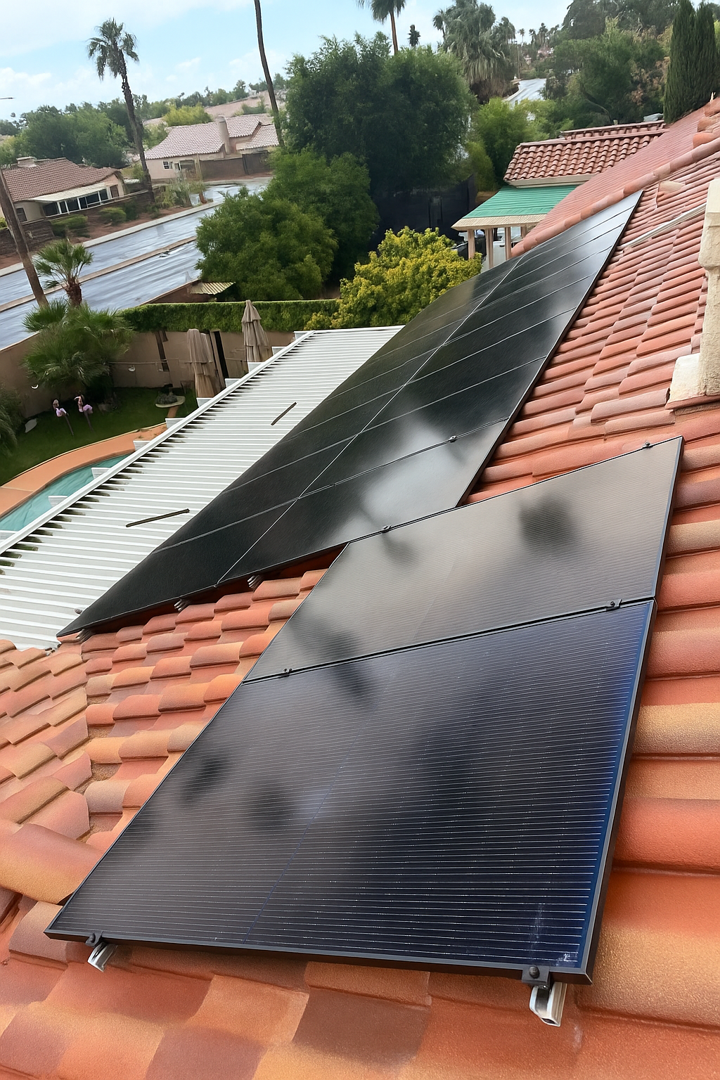
Solar power installation cost is more affordable than you might think. Understanding what you're paying for is the first step toward energy independence.
Quick Answer: What Does Solar Cost?
Average cost per watt: $2.74–$3.30/watt
Typical residential system (8 kW): $21,900–$26,400 before incentives
After 30% federal tax credit: $15,330–$18,480
Payback period: 6–12 years
Long-term savings: $37,000–$148,000 over 25 years
Cost decrease since 2010: 75% (from $7/watt to less than $3/watt)
What surprises most homeowners is that the solar panels themselves only make up about 12% of the total installation cost. The rest covers inverters, mounting equipment, labor, permits, and other "soft costs" like design and engineering.
Thanks to a 75% drop in costs since 2010, solar has never been more accessible for Southwest homeowners. Federal tax credits cover 30% of your system cost, and local incentives can lower the price even further. You're not just buying panels; you're investing in long-term savings and energy security. Most homeowners break even in 7–10 years and enjoy free electricity for another 15–20 years after.
I'm Stanford Johnsen, Founder of Capital Energy. I've helped thousands of Southwest homeowners steer the solar power installation cost to make smart energy decisions. My goal is to show you exactly what you're paying for and why it's one of the best investments for your home.

Breaking Down the Solar Power Installation Cost
While the panels are the most visible part of a solar system, they only represent about 12% of the total solar power installation cost. The full price tag is a mix of hardware (about 40%) and "soft costs" like labor and permits (the remaining 60%).
For an average 8-kilowatt residential system in the Southwest, the total cost is between $2.74 and $3.30 per watt, or roughly $21,900 to $26,400 before incentives. Larger systems often have a lower cost per watt; for example, a 12 kW system on EnergySage averages $2.53 per watt.
Let's break down where your investment goes. The U.S. Department of Energy on Soft Costs provides great background on these expenses. To see how it all works, check out more info about how solar works.
Hardware Costs (~40% of Total)
These are the physical components of your system.

Solar Panels (12%): The component everyone thinks of is one of the smaller line items. Premium, high-efficiency panels cost more but are worth it for homes with limited roof space.
Inverters (10%): This is the brain of your system, converting DC electricity from your panels into AC electricity your home uses. The type you choose affects performance and price.
Racking and Mounting (3%): This framework securely anchors panels to your roof and varies based on roof type (shingle, tile, metal) and local building codes.
Wiring and Electrical (9%): This includes all cables, conduits, and disconnects that safely connect the system. Quality is crucial for safety and performance.
Battery Storage (Optional): A battery system adds $10,000 or more before incentives but provides backup power during outages and allows you to use stored solar energy at night. For Arizona homeowners, we offer more info about battery options.
Soft Costs (~60% of Total)
These "invisible" costs are what turn equipment into a functioning power plant on your roof.
Installation Labor (7%): This pays for the skilled technicians who safely and correctly install your system, ensuring it performs as designed.
Design, Engineering & Project Management (28%): Experts assess your energy needs, analyze your roof's sun exposure, and create custom blueprints to optimize your system for your home.
Permitting and Inspection Fees ($110–$760): These fees, which vary by city, cover plan reviews and inspections that verify your system meets all safety and structural codes.
Interconnection Fees: Your utility company charges this fee to connect your system to the grid, allowing you to send excess power back and draw power when needed.
Business Operations (40%): This covers sales and marketing (18%), company overhead like rent and insurance (11%), and installer profit (11%). These costs allow a company like Capital Energy to educate homeowners, operate efficiently, and provide long-term support.
What Determines Your Final Solar Price Tag?
The average solar power installation cost is a helpful starting point, but your final price will be unique to your home. Just like buying a car, your specific needs and preferences shape the final cost. I've seen neighbors on the same street get different quotes because solar isn't one-size-fits-all. Let's walk through the key factors.

Key Factors Influencing Your Solar Power Installation Cost
System Size (kW): This is the biggest cost driver and is based on your electricity usage. A larger home with high energy needs (like running central AC in Arizona) requires a bigger system. However, the cost per watt typically decreases as system size increases because fixed costs like design and permitting are spread across more panels.
Energy Consumption (kWh): We analyze your past 12 months of electricity bills to determine your exact usage patterns. This ensures we design a system that meets your needs without being oversized.
Equipment Quality and Type: Higher-efficiency panels cost more but generate more power in less space, which is ideal for smaller or partially shaded roofs. The inverter technology you choose also affects performance and price, while premium warranties offer decades of peace of mind.
Panel and Inverter Types
The technology you choose directly impacts your system's performance and total solar power installation cost.
Panel Type | Cost (per panel, installed) | Efficiency Rate (average) | Lifespan (average) | Best Use Case |
Monocrystalline | $1,200 | 15%–22% | 25+ years | Limited space, high efficiency needed |
Polycrystalline | $850 | 13%–17% | 25+ years | Cost-effective, ample space |
Thin-film | $500 | 6%–15% | 10–20 years | Versatile, lightweight, less common for residential |
Note: Cost per panel (installed) includes installation, mounting, and electrical work, not just the panel itself.
Monocrystalline panels are the premium choice, offering the highest efficiency (up to 22%) and a sleek, dark appearance. They are ideal for maximizing production on roofs with limited space.
Polycrystalline panels are a budget-friendly option with slightly lower efficiency (13%–17%). They are an excellent choice if you have ample roof space and cost is a primary concern.
Regarding inverters, string inverters are the most economical but can be less efficient if some panels are shaded. Microinverters attach to each panel, maximizing output by allowing them to operate independently, which is great for complex or shaded roofs but comes at a higher cost. Power optimizers offer a middle ground, providing panel-level optimization with a central inverter for a balance of performance and value.
Home and Location Specifics
Your home's unique traits and location can alter your final cost significantly.
Roof Condition and Material: If your roof has less than 10–15 years of life left, we strongly recommend replacing it first. Removing and reinstalling panels later is expensive. Tile roofs also require more specialized labor than standard asphalt shingles, which adds to the cost.
Shading: Shade from trees or buildings reduces efficiency. This may require more panels or an investment in microinverters or power optimizers. Sometimes, tree trimming ($300-$1,500) is the most cost-effective solution.
Electrical Panel Upgrade: Many older homes need their main electrical panel upgraded to a modern 200-amp panel to safely handle the solar system's power. This can add several hundred to a few thousand dollars to the project.
Geographic Location: Costs vary across the Southwest due to local labor rates, permitting rules, and competition. In 2024, an 8 kW system in Arizona averaged $2.54/watt, while California was higher at $2.83/watt.
Your Choice of Installer: The cheapest quote isn't always the best. As a vertically integrated company, Capital Energy controls every aspect of your installation, ensuring quality and accountability. This might not be the lowest price, but it provides the best long-term value and peace of mind.
Open uping the Financial Benefits: Incentives, Savings, and ROI
Understanding the upfront solar power installation cost is important, but the real story is the long-term financial return. We're talking about tens of thousands of dollars in savings over the life of your system.
Most homeowners have a payback period of 6–10 years, after which they generate free electricity for another 15–20 years. Over 25 years, typical savings range from $37,000 to $148,000. The average return on investment (ROI) for solar is around 10%, outperforming many traditional investments.
Financing Your System: Cash or Loan
You have options when paying for your solar system.
Paying cash upfront provides the greatest financial benefit. You own the system immediately, qualify for all tax credits, and have no interest payments.
A solar loan is the most popular option, allowing you to go solar with little to no money down. You still own the system and get all the tax credits. Your monthly loan payment is often less than your old utility bill, meaning you save from day one. While you'll pay interest, you're building equity in an asset that increases your home's value.
We offer various financing solutions to fit your budget. Check out more info about new solar programs to explore your options.
Tax Credits and Incentives That Lower Your Net Cost
Incentives make the solar power installation cost much more manageable.
The main incentive is the Federal Solar Tax Credit, which gives you 30% back on your entire system cost. This is a dollar-for-dollar reduction in your federal income tax. For example, a $25,000 system earns you a $7,500 tax credit. This incentive is available through 2032. For details, see the IRS guidance on the Residential Clean Energy Credit.
Many states and cities in the Southwest also offer additional rebates and tax credits. The DSIRE database for local incentives is a great resource to see what's available in your area. Furthermore, many states offer property and sales tax exemptions, which means your property taxes won't increase with your home's new value, and you may not have to pay sales tax on the equipment.
Solar's Impact on Home Value
Installing solar panels is an investment in your property's long-term wealth.
Research from sources like Zillow research on solar home values consistently shows that homes with solar panels sell for about 4% more than comparable homes without them. On a $400,000 home, that's a $16,000 increase in value.
Solar homes also sell about 20% faster. In a competitive market, this is a significant advantage. Buyers value lower electricity bills, making your home more attractive. Plus, with property tax exemptions in many states, you get the increased home value without the higher tax bill.
Advanced Considerations and Overlooked Costs
While the main components of solar power installation cost are straightforward, it's wise to be aware of a few advanced considerations and potential long-term costs. We believe in full transparency, so let's explore these aspects.
Potential 'Hidden' Costs of Solar Ownership
Maintenance and Cleaning ($150–$300/year): Occasional cleaning, especially in dusty Southwest climates, can boost energy production by 3–5%. Annual inspections are also recommended.
Inverter Replacement (every 10–15 years): Inverters have a shorter lifespan than panels (25-30 years) and will likely need to be replaced once during the system's life.
Roof Repairs and Panel Removal/Reinstallation ($1,000–$3,000+): If your roof needs replacement, panels must be removed and reinstalled, adding cost. This is why we advise assessing your roof's condition beforehand.
Insurance Adjustments: Your homeowner's policy may need an update to cover the added value of your solar system, which could slightly increase your premium.
Residential vs. Commercial Solar Power Installation Cost
Costs differ significantly between residential and commercial projects due to scale and complexity.
Scale and Cost Per Watt: Residential systems (5-15 kW) average $2.50–$3.50 per watt. Larger commercial projects (50 kW+) benefit from economies of scale, often dropping the cost to $1–$2.50 per watt.
Incentives: Both get the 30% federal tax credit, but commercial projects can also use accelerated depreciation (MACRS) and other grants, drastically reducing their net cost.
Installation Methods and International Price Gaps
The installation method also influences price.
Rooftop: The most common and cost-effective method for homes.
Ground-Mount: More expensive due to costs for framing, foundation, and trenching. Expect to pay $20,000 to $40,000 before incentives.
Carport: Offers dual use but is more expensive than rooftop due to structural requirements.
U.S. solar costs can be higher than in other countries due to factors like tariffs on imported components, complex local permitting processes, and higher labor costs.
Frequently Asked Questions about Solar Installation Costs
We hear these questions all the time from homeowners across the Southwest. Here are straight answers to the most common concerns about solar power installation cost.
Do I need to replace my roof before installing solar panels?
Yes, if your roof has less than 10–15 years of life remaining, we highly recommend it. Removing and reinstalling solar panels for a future roof replacement is costly (typically $1,000–$3,000+). It's far more cost-effective to install your system on a new roof that will last as long as your panels.
How much does a solar system for a 2,000-square-foot house cost?
Solar power installation cost is based on your electricity usage (kWh), not your home's square footage. A 2,000 sq. ft. home with high AC use will need a larger, more expensive system than an energy-efficient home of the same size.
As a ballpark estimate, a system for an average 2,000 sq. ft. home might cost $19,000 to $22,000 before incentives. After the 30% federal tax credit, that comes down to $13,000 to $15,500. The only way to know for sure is to get a custom quote based on your actual energy bills.
Is it better to buy or lease a solar panel system?
Buying your system—with cash or a loan—provides the greatest long-term financial return. When you own the system, you are eligible for all tax credits and incentives, like the 30% federal credit. Every dollar of electricity savings goes directly to you, and the system adds significant value to your home.
A solar loan is an excellent option that allows you to own the system with little to no upfront cost. Your loan payment is often less than your old utility bill, and once it's paid off, you own an asset that generates free power for decades. Both buying options put you in control of your energy future and build equity in your home.
Conclusion
Now you have a solid understanding of what goes into solar power installation cost. The key takeaway is that the panels themselves are only a small fraction (about 12%) of the price. The majority of the cost covers the expert engineering, labor, and permitting required to ensure your system performs flawlessly for decades.
With costs down 75% since 2010 and a 30% federal tax credit available, solar makes clear financial sense for most Southwest homeowners. You can expect to break even in 6 to 12 years and then enjoy free electricity, with total savings of $37,000 to $148,000 over the system's life. It's an investment that adds value to your home, protects you from rising utility rates, and benefits the environment.
At Capital Energy, we make this process smooth and transparent. As a vertically integrated company, we handle everything from design to installation and support, ensuring a seamless experience with top-tier technology. We've helped thousands of homeowners in Arizona, California, Nevada, and Texas achieve energy independence.
If you're ready to see what a solar system would cost for your home, let's talk. We provide honest answers and a personalized plan designed for your goals.
Your energy independence starts here.


Solar Brighton :- This is a valuable resource for anyone researching solar panel installation. The right panel system, suitable roof space, and proper installation are all important parts of a successful solar setup.