
Solar Panels and Temperature: Debunking Myths and Boosting Output
- 8 minutes ago
- 10 min read
Introduction: The Surprising Truth About Solar Panels and Heat

How does temp affect solar panels? It’s a common myth that hotter, sunnier days equal maximum solar production. While panels need sunlight, extreme heat is the enemy of efficiency. For every degree Celsius above 25°C (77°F), most solar panels lose 0.3% to 0.5% of their power output. On a scorching summer day, this can mean a 10-25% drop in performance.
Key Temperature Effects on Solar Panels:
Optimal Temperature: Panels are rated at 25°C (77°F), their peak efficiency point.
Heat Penalty: Efficiency drops by 0.3-0.5% for each degree Celsius above 25°C.
Voltage Drop: Heat primarily reduces a panel's voltage, lowering total power output.
Cold Weather Bonus: Below 25°C, panels produce more power than their rating.
This reality is critical in the Southwest. On a roof in Phoenix, Tempe, or Las Vegas, panel surfaces can exceed 65°C (150°F), making heat management essential for maximizing your investment.
I'm Stanford Johnsen, Founder of Capital Energy. For years, my team has designed solar systems across Arizona, Nevada, Texas, and California, mastering how to combat our region's extreme heat. We've helped thousands of homeowners optimize their systems to minimize these heat-related losses.
This guide will explain the science in simple terms and provide actionable strategies to ensure your solar array performs at its peak. You'll learn how to make informed decisions about your solar investment, from choosing the right technology to understanding proper installation.

The Science Behind Solar Panels and Heat
Solar panels need sunlight to work, but excessive heat makes them less efficient at converting that light into electricity. This phenomenon is rooted in the physics of how solar cells operate.
Solar cells use the photovoltaic effect to convert photons from sunlight into a flow of electrons (an electric current). When photons strike the semiconductor material (usually silicon), they excite electrons, knocking them loose to generate power.

However, heat interferes with this process, significantly reducing a panel's output.
What is the Optimal Temperature for Solar Panels?
The solar industry uses a benchmark temperature of 25°C (77°F) for rating panels. These are called Standard Test Conditions (STC), and they provide a consistent way to compare performance.
The efficiency rating on a panel's spec sheet assumes it's operating at exactly 25°C. In the real world, temperatures almost always deviate from this, affecting how much power your panels actually produce.
Research on thermal effects on solar cells confirms that as temperature rises, performance drops in a predictable, linear way. This is why a cool, sunny day can be more productive than a scorching summer afternoon.
Understanding the Temperature Coefficient
To predict how panels perform in real-world heat, we use the temperature coefficient. Found on a panel's datasheet, this number tells you how much power is lost for every degree Celsius above 25°C. For most panels, this value is between -0.30% to -0.45% per °C.
For example, a panel with a -0.40%/°C coefficient operating at 65°C (40°C above the standard) will see a 16% reduction in power output (40 × 0.40%). Conversely, on a cold 5°C day (20°C below standard), that same panel would produce 8% more power than its rating.
At Capital Energy, we prioritize panels with lower negative coefficients (e.g., -0.35% vs. -0.45%) for Southwest installations, as they perform better in our hot climate. Over 25 years, this small difference adds up to significant savings.
The Physics: Why Heat Reduces Voltage
Why does heat reduce efficiency? It comes down to the semiconductor material. As temperature rises, electrons become more energetic. While this sounds good, it leads to two problems.
First, there's a higher chance that energized electrons will "recombine" before they can be collected as current, effectively leaking away potential power. The most significant impact, however, is on voltage. As temperature increases, the panel's open-circuit voltage (Voc) drops substantially. The short-circuit current (Isc) increases slightly, but not enough to offset the voltage loss.
Since power is voltage multiplied by current (P = V × I), a major drop in voltage results in a net decrease in overall power output. This voltage drop is the primary reason heat is the enemy of solar panel efficiency. We can't change physics, but we can design systems that minimize heat buildup and choose technologies that handle it better.
How Does Temp Affect Solar Panels? Key Environmental and Installation Factors
A panel's operating temperature isn't just about the weather; it's a result of environmental conditions, installation choices, and your roof itself. After designing thousands of systems across Arizona, Nevada, and other Southwest states, we know that managing these factors is key to a high-performing system.

How does temp affect solar panels in different climates?
Climate fundamentally shapes your solar experience. In hot Southwest climates like Phoenix and Las Vegas, panel surfaces can reach 60-65°C (140-149°F). While we have incredible sunlight (irradiance), the high temperatures cause efficiency losses of 10-15% during the hottest parts of the day. Our designs are specifically engineered to combat this heat.
Conversely, cold climates give solar panels a performance boost. For every degree below the optimal 25°C (77°F), efficiency increases. On a crisp, clear winter morning, panels can produce 5-7% more power than their rated output.
The Impact of Installation and Surroundings
How panels are mounted matters enormously. Here are the key factors we consider:
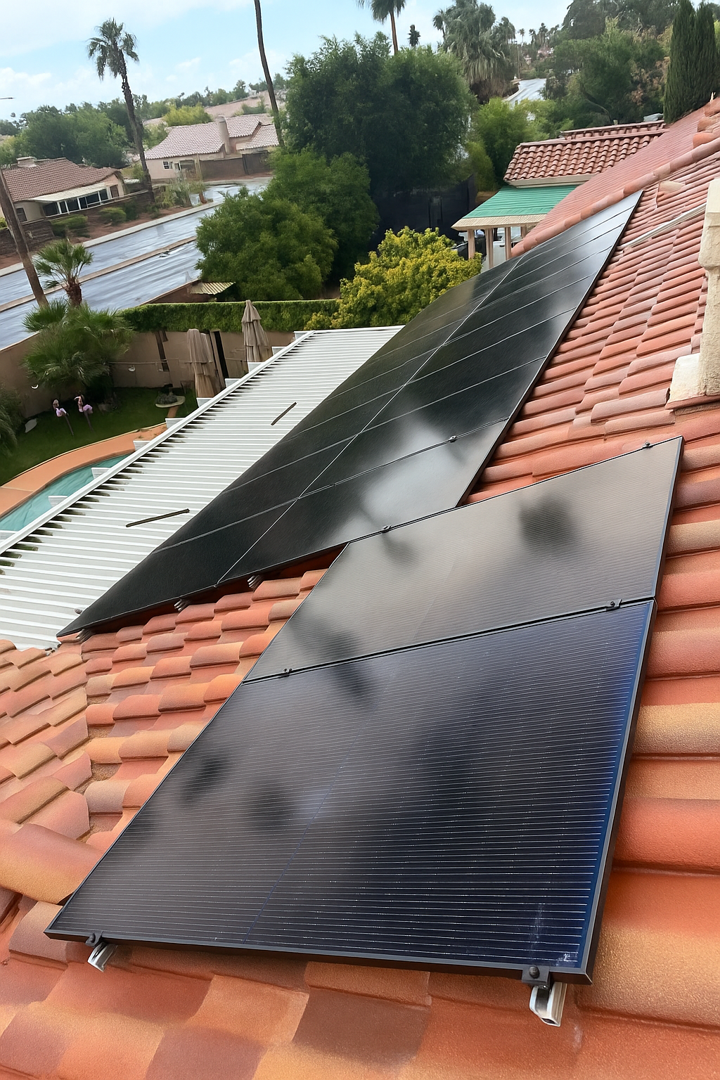
Airflow and Ventilation: Panels need to breathe. Trapped hot air causes temperatures to skyrocket. We ensure a sufficient air gap (ideally 20 cm) between the panels and the roof, which can reduce panel temperature by up to 10°C. This simple step can improve output by 4%.
Mounting Method: Ground-mounted systems naturally run cooler than roof-mounted ones because air circulates freely around them. When installing on a roof, we use mounting hardware that maximizes the air gap to encourage natural cooling.
Roof Color and Material: A dark asphalt roof can reach 80°C (176°F), radiating heat directly into the panels above. A white or light-colored roof can be up to 30°C cooler, which helps keep panels running more efficiently. A variety of factors can impact solar performance and efficiency, and roof characteristics are high on the list.
Shading and Hot Spots: When a single cell is shaded, it can act as a resistor, creating a "hot spot" that generates heat and drags down the performance of the entire panel. Proper design and bypass diodes help prevent this.
Weather's Role: More Than Just Sunshine
Daily weather also plays a part in how hot your panels get:
Ambient Air Temperature: Panels typically operate 20-40°C above the surrounding air temperature. So on a 40°C (104°F) day, your panels could be as hot as 80°C (176°F).
Solar Irradiance: Intense sunlight generates more electricity but also more heat. Panel temperatures usually peak in the early afternoon.
Wind Speed: Wind is a powerful, natural cooling mechanism. Even a gentle breeze can reduce panel temperatures by 5-11°C, sweeping away hot air.
Humidity and Cloud Cover: High humidity can slightly scatter sunlight, while clouds reduce both heat and production.
Understanding these factors allows us at Capital Energy to provide accurate production estimates custom to your specific property and local weather patterns.
Maximizing Your Output: Strategies to Mitigate Heat
Losing 10-25% of your power on a hot day is significant, but smart design and modern technology can keep your panels cool and productive. When considering how does temp affect solar panels, these mitigation strategies are key to boosting your system's output.
Passive Cooling: Smart Design and Installation
The most cost-effective way to fight heat is through intelligent design that encourages passive cooling.
Proper Ventilation and Air Gap: This is our golden rule. We ensure sufficient space between the panels and the roof for natural convection, where cool air flows underneath and pushes hot air away. A generous air gap can reduce panel temperature by up to 10°C.
Rack Mounting: Rack-mounted systems generally offer better airflow than flush-mounted ones, helping to keep panels cooler.
Lighter-Colored Roofing: If you're re-roofing, choosing a light-colored material can keep your roof up to 30°C cooler, which in turn cools your panels and improves performance.
Strategic Placement: We design the array layout to promote natural air movement and avoid trapping heat.
The Role of System Components in Managing Heat
Beyond installation, modern solar components actively manage temperature effects.
Smart Inverters and MPPT: The inverter is the brain of your system. Modern inverters use Maximum Power Point Tracking (MPPT) to continuously adjust voltage and current to find the sweet spot for maximum power production as temperature changes. This can improve system efficiency by 1-3%.
Micro-inverters and Power Optimizers: These devices are installed on each panel, optimizing them individually. If one panel gets hotter than others, it won't reduce the performance of the entire string. This is ideal for managing temperature variations across a roof.
System Monitoring: Our systems include advanced monitoring, allowing us to track performance in real-time. This helps identify any unexpected efficiency drops due to heat or other issues, ensuring your system is always performing optimally.
Bypass Diodes: Built into panels, these small devices route current around underperforming or shaded cells. This prevents the formation of "hot spots" that can damage the panel and reduce output.
By implementing these strategies, we not only boost immediate output but also protect your investment by reducing the long-term degradation that can be accelerated by chronic heat exposure.
Not All Panels Are Created Equal: Temperature's Effect on Different Technologies
Different types of solar panels respond differently to high temperatures. When designing a solar solution for the Southwest, selecting the right panel technology is a critical decision that directly impacts how does temp affect solar panels in your installation.
Panel Type | Temperature Coefficient | Typical Efficiency | Best For |
Monocrystalline | -0.35% to -0.45% per °C | 15% to 22%+ | High efficiency needs, space-limited installations |
Polycrystalline | -0.38% to -0.50% per °C | 13% to 18% | Budget-conscious projects with adequate space |
Thin-Film (a-Si, CdTe) | -0.10% to -0.25% per °C | 6% to 22% | Extreme heat environments, large available areas |
Bifacial | -0.30% to -0.40% per °C | 18% to 24%+ | Ground-mounted systems, reflective surfaces |
How does temp affect solar panels of different types?
Monocrystalline Panels: Made from a single silicon crystal, these are highly efficient (15-22%+) and are our go-to for residential projects with limited roof space. Their high baseline efficiency often means they still outperform other types even when hot.
Polycrystalline Panels: A budget-friendly option made from multiple silicon fragments. Their efficiency is slightly lower (13-18%), and they are slightly more affected by heat, but they offer solid, reliable performance for larger installations.
Thin-Film Panels: These panels have a secret weapon for hot climates: a superior temperature coefficient (as low as -0.10% per °C). While their overall efficiency is lower, they lose far less power in extreme heat, making them a smart choice if you have ample space.
Bifacial Panels: These innovative panels capture light from both sides. This design also allows for better heat dissipation, leading to lower operating temperatures. They are especially effective in ground-mounted systems over reflective surfaces.
Advanced Materials and Future-Proofing
The solar industry is constantly innovating to combat heat. High-efficiency panels have an advantage because they convert more sunlight into electricity and waste less as heat, allowing them to run 2-5°C cooler.
Manufacturers are also developing panels with lower temperature coefficients, with some premium models boasting values as low as -0.26% per °C. Emerging technologies like integrated phase change materials (PCMs) and special reflective coatings promise even better heat management in the future.
At Capital Energy, we stay on the cutting edge of these technologies. Our vertically integrated approach allows us to quickly adopt and deploy new solutions that make sense for our Southwest climate, ensuring your solar investment delivers maximum returns for decades.
Frequently Asked Questions about Solar Panel Temperature
Here are answers to the most common questions we get from homeowners across Arizona, Nevada, and Texas about how temperature affects solar panels.
Do solar panels work in the snow?
Yes, and surprisingly well once the snow clears. While a heavy blanket of snow will block sunlight, the cold temperatures actually boost panel efficiency, allowing them to produce more power than their rating. Panels are installed at an angle, so light snow often slides off. The reflection from surrounding snow (albedo effect) can also increase production.
Can solar panels overheat and get damaged?
This is a common concern, but damage from heat alone is extremely rare. Quality solar panels are certified to operate reliably at very high temperatures (up to 85°C / 185°F). While efficiency drops in the heat, the panels do not break down.
However, chronic exposure to extreme heat can accelerate long-term degradation over the panel's 25+ year lifespan. This is why our heat mitigation strategies are so important for protecting your investment.
How much power will I actually lose on a hot day?
The exact amount depends on your panel's temperature coefficient and the operating temperature. Let's use a real-world example: a panel with a common -0.4% per °C coefficient is rated at 25°C. On a hot day, its surface might reach 65°C (40°C above the standard).
To calculate the loss: 40°C × 0.4% = 16% potential power loss. A 320-watt panel would produce closer to 269 watts. This is why our team at Capital Energy designs every system to keep panels as cool as possible, maximizing your energy production even on the hottest days.
Conclusion: Designing a Resilient Solar System for Your Climate
So, how does temp affect solar panels? The answer is clear: while sunlight is essential, the heat that comes with it can reduce efficiency by 10-25% on the hottest days. In the Southwest, where panel surfaces can reach 150°F, this is a critical factor that impacts your return on investment.
The good news is that you can control how your system responds to heat. Smart design choices—from ensuring proper ventilation and choosing panels with superior temperature performance to incorporating advanced inverters—make all the difference. These aren't minor details; they are the foundation of a system that thrives in the heat, rather than just surviving it.
At Capital Energy, we have spent years perfecting solar installations across Arizona, Nevada, California, and Texas. Our vertically integrated approach means we engineer resilient energy systems built specifically for the Southwest. We handle every step, from a design that prioritizes airflow and cooling to professional installation and ongoing support.
Your solar investment represents decades of energy savings. By partnering with experts who truly understand how to manage our region's extreme conditions, you ensure that investment pays off to its fullest potential. You deserve a system that delivers exceptional performance, even when the desert sun is at its most intense.
Ready to design a solar system engineered to conquer Southwest heat? Learn more about our comprehensive solar design and installation services and let's build a system that will produce clean, efficient energy for decades to come.


Comments