
Sustainable Choices for Renewable Energy
Why Renewable Energy Solutions Matter Now More Than Ever

Renewable energy solutions are systems that generate power from naturally replenished sources like sunlight, wind, and water, offering a path to lower energy bills, a reduced environmental impact, and greater energy independence. Key solutions include solar power, wind energy, and battery storage, all optimized with smart technology.
Why do they matter now? Renewable energy now costs less than fossil fuels in most regions, creates three times more jobs per dollar invested, and can save thousands annually on electricity bills. Critically, clean energy reduces air pollution, which is linked to 7 million premature deaths worldwide each year.
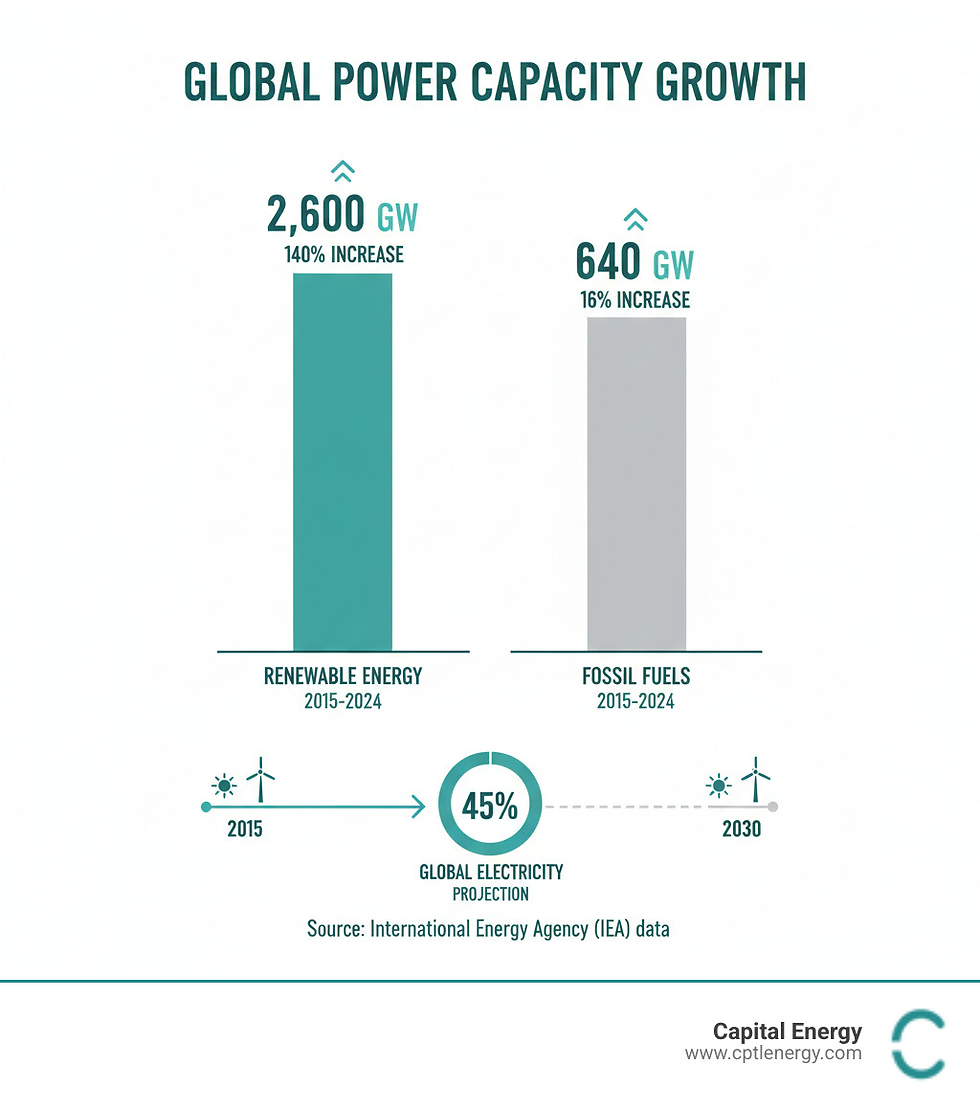
The power sector is the largest source of global greenhouse gas emissions, and we must cut emissions nearly in half by 2030 to avoid the worst climate impacts. While fossil fuels still generate nearly 60% of our electricity, the good news is that renewable capacity surged 140% between 2015 and 2024, with most new projects costing less than fossil fuel alternatives.
For Southwest homeowners facing scorching summers and climbing utility bills, this shift is both an environmental imperative and a financial opportunity. As Stanford Johnsen, Founder and Chief Sales Officer of Capital Energy, I've helped thousands of families across the Southwest implement these solutions. My mission is to make clean power accessible and affordable, helping homeowners stop overpaying for electricity while building a more sustainable future.
The Spectrum of Clean Energy Sources
Renewable energy solutions are a family of technologies that tap into nature's endless resources. Unlike fossil fuels, which are a finite resource, renewables like the sun and wind replenish themselves faster than we can use them.
Here in the Southwest, we're blessed with some of the best solar resources on the planet. That's why Capital Energy has focused our expertise on delivering vertically integrated solar solutions—it's the most practical choice for homeowners in Arizona, California, Nevada, and Texas. But understanding the full spectrum of clean energy helps you see how your rooftop solar fits into a bigger picture.
Solar Energy: Using the Sun
For those of us under 300+ days of sunshine annually, solar energy is a no-brainer. The sun delivers more energy to Earth in one hour than humanity uses in an entire year, and modern technology is remarkably good at capturing it.
Photovoltaic (PV) panels use semiconductor materials to convert sunlight directly into electricity. The cost of manufacturing these panels has plummeted, making solar not just competitive with fossil fuels but often the cheapest way to generate electricity. A typical solar panel system lasts roughly 30 years, delivering decades of clean power.
Residential solar is where the rubber meets the road for homeowners. Rooftop PV systems can dramatically reduce or even eliminate your electricity bills. Grid-tied systems offer reliability, while systems paired with battery storage can provide complete energy independence. Many homeowners even sell excess energy back to the grid through net metering programs, speeding up their return on investment.
Commercial solar works the same way but at a larger scale, helping businesses slash operating costs and boost their environmental credentials. Global solar capacity has surged, now providing 6–7% of the world's electricity, driven by falling prices and smart incentives. According to the International Energy Agency's Renewables 2023 report, solar continues to lead global renewable expansion.
We guide our clients through every phase—from design and installation to ongoing support—all under one roof. We also help you steer incentives that make solar more accessible. The Database of State Incentives for Renewables & Efficiency shows what's available in your area, and we're experts at securing these benefits for homeowners.

Wind and Water: Powering the Grid
While solar dominates the Southwest, other renewable technologies are building a resilient clean energy grid nationwide.
Wind power uses massive turbines to capture the kinetic energy of moving air. Its technical potential is enormous—experts believe wind could produce five times more energy than the entire world currently uses. Offshore wind farms take advantage of stronger, more consistent winds over oceans.
Hydropower has been a renewable workhorse for over a century, using the flow of water to generate electricity. It currently ranks as the largest source of renewable electricity globally and is one of the most efficient, with a conversion efficiency of about 90%.
The International Renewable Energy Agency (IRENA) projects that 90 percent of the world's electricity can and should come from renewable energy by 2050. This goal highlights the importance of all clean energy sources working together.
Geothermal energy taps into the Earth's internal heat. While large-scale plants are geographically limited, geothermal heat pumps can efficiently heat and cool homes almost anywhere. Biomass, which uses organic materials for energy, rounds out the renewable family but requires careful management to be sustainable.
For Southwest homeowners, however, solar remains the clearest and most immediate path to energy independence and cost savings.
The Overwhelming Benefits of Going Green
Switching to renewable energy solutions is one of the smartest financial decisions you can make, and it happens to be great for the planet. At Capital Energy, we're not just selling solar panels; we're offering a path to energy independence, lower bills, and a healthier future.
Economic Advantages
Let's start with the money. Lower electricity bills are the first benefit you'll notice. In the Southwest, where summer cooling costs are brutal, the savings are dramatic. You generate your own power at a fixed cost for decades, free from utility rate hikes. Solar and offshore wind are now 41 percent and 53 percent cheaper than fossil fuels, respectively, making them the most affordable power source in most of the world.
The renewable energy sector is also a job-creation engine. In 2023, 16.2 million people were employed in renewable energy worldwide. For every dollar invested, renewables create three times as many jobs as the fossil fuel industry, boosting local economies in Arizona, California, Nevada, and Texas. You can learn more in the Renewable energy and jobs Annual review 2024.
Other benefits include increased property value, as energy-efficient homes are in high demand, and energy independence. Generating your own power insulates you from the price spikes and geopolitical disruptions that affect fossil fuels. With falling installation costs and strong incentives, the return on investment for solar has never been better.
Energy Source | Levelized Cost of Energy (LCOE) Range (USD/MWh) |
Solar PV (Utility-Scale) | 24-96 |
Onshore Wind | 24-75 |
Offshore Wind | 72-133 |
Coal | 68-166 |
Natural Gas (Combined Cycle) | 39-101 |
Note: Data from Lazard's Levelized Cost of Energy Analysis. Costs vary based on location, project specifics, and market conditions.
Environmental and Health Co-Benefits
Adopting renewable energy solutions creates ripple effects that improve life for everyone.
Reduced greenhouse gas emissions are the primary environmental benefit. By switching to solar, you directly help decarbonize the power sector, which is the largest source of global emissions. Renewables could provide 65% of the world's electricity by 2030 and decarbonize 90% of the power sector by 2050.
An immediate co-benefit is cleaner air. Air pollution from burning fossil fuels is associated with 7 million premature deaths every year and causes respiratory illnesses, heart disease, and cancer. You can find more information from the WHO data on air pollution deaths. When you switch to solar, you reduce demand for fossil fuel power plants, leading to cleaner air for your community.
Water conservation is another critical benefit, especially in the arid Southwest. Traditional power plants use vast amounts of water for cooling, while solar PV and wind technologies use significantly less, preserving this precious resource.
Going green isn't about sacrifice. It's a smart choice that pays dividends for your finances, your community's health, and our shared future.
Your Guide to Implementing Renewable Energy Solutions
Making the switch to clean energy can feel overwhelming, but with the right partner, the journey is straightforward. At Capital Energy, our vertically integrated approach means we handle everything under one roof. You get one team, one vision, and one commitment to your success.
From Concept to Creation: The Project Lifecycle
Our process is a clear, step-by-step journey designed around your needs.
Initial Consultation: We sit down to understand your goals, whether it's cutting costs, gaining energy independence, or reducing your environmental impact.
Site Assessment: Our technical team conducts a thorough evaluation of your property, analyzing roof space, sun exposure, and historical energy data to build an accurate performance model.
Specification and Design: Our designers create a system customized to your property and energy needs, using cutting-edge technology to optimize panel placement and integrate battery storage if desired.
Proposal: We present a detailed proposal with system specifications, projected energy production, and a full financial analysis, including ROI, payback periods, and all applicable incentives.
Permitting and Compliance: Our team handles all necessary permits and ensures full regulatory compliance with local, state, and federal codes, including standards like California's Title 24.
Integration and Commissioning: Our certified professionals install your system with meticulous attention to detail, then thoroughly test and commission it to verify optimal performance and safety.
Ongoing Support and Maintenance: Our relationship doesn't end at installation. We monitor your system's performance and provide proactive maintenance to ensure it runs at peak efficiency for its entire 30-year lifespan.
Navigating Challenges and Regulations
Implementing renewable energy solutions has challenges, but every one has a solution.
High upfront costs are a common concern, but federal and state incentives can dramatically reduce your out-of-pocket expenses. We are experts at securing these aids, which you can explore on the Database of State Incentives for Renewables & Efficiency. Your system also pays for itself over time through energy savings.
Intermittency issues (the sun doesn't always shine) are solved with modern battery energy storage systems and smart grid integration, ensuring you have consistent power.
The regulatory landscape can be a maze of local and state rules. We make it our business to master these regulations across Arizona, California, Nevada, and Texas, so you don't have to.
Grid integration requires careful coordination with your utility company. We handle this directly, ensuring your system integrates safely and seamlessly with the existing infrastructure.
Finding qualified installers you can trust is crucial. Our team consists of certified professionals who handle the work in-house, ensuring consistent quality and accountability. If an issue arises, you call us, and we take care of it.
The Future of Energy: Storage, Data, and Optimization
The true power of modern renewable energy solutions lies not just in generating clean electricity, but in intelligently managing it. This is where cutting-edge technology turns intermittent sunshine into reliable, always-on power.
The Critical Role of Energy Storage
Energy storage, particularly through Battery Energy Storage Systems (BESS), is a game-changer for solar. It's like a personal energy bank that allows you to:
Store Excess Solar Power: Save the extra energy your panels produce on sunny days for use at night, on cloudy days, or during peak hours when utility rates are highest.
Power Your Home During Outages: When the grid goes down, your battery can keep essential appliances running. For our clients in Arizona, California, Nevada, and Texas, this means staying cool and safe during extreme weather.
Maximize Self-Consumption: By storing and using your own power, you reduce reliance on utility companies and maximize your savings. Lithium-ion batteries are the most common and cost-effective technology for residential and commercial BESS.
Energy storage is also crucial for grid stability, enabling services like demand charge management for commercial clients and allowing deeper integration of renewables into the national grid.
Leveraging Technology to Optimize Your System
At Capital Energy, we use technology to ensure your renewable energy solutions are optimized for peak performance and maximum savings.
Real-time Monitoring: Track your energy production and consumption instantly to see exactly how your system is performing.
AI-Powered Optimization: Our systems use AI to learn your usage patterns, intelligently adjusting battery charging and discharging to maximize savings through strategies like energy arbitrage.
Predictive Maintenance Alerts: Automated alerts notify us of potential issues before they become major problems, minimizing downtime and ensuring the longevity of your investment.
Microgrids and EV Charging: For greater resilience, we design self-sufficient microgrids. We also integrate EV charging infrastructure, allowing you to power your vehicle with clean, self-generated electricity.
Frequently Asked Questions about Renewable Energy
Making the switch to renewable energy solutions is a big decision, and you've got questions. Here are the most common ones we hear at Capital Energy.
How much can I save by switching to solar power?
Your savings depend on your electricity use, system size, and local utility rates. However, most of our clients across Arizona, California, Nevada, and Texas see a dramatic drop in their monthly bills, often saving thousands of dollars annually.
During our consultation, we provide a detailed financial projection based on your specific data, showing your exact return on investment and payback period. With solar now 41 percent cheaper than fossil fuels in most areas, the economics have never been more compelling.
What happens during a power outage if I have solar panels?
This is a critical question in the Southwest. A standard grid-tied solar system without a battery will automatically shut down during an outage as a safety measure for utility workers.
However, when you pair your solar panels with a battery energy storage system (BESS), everything changes. Your home seamlessly switches over to stored battery power, keeping your air conditioning, refrigerator, and other essentials running. This provides invaluable comfort and safety during blackouts, ensuring you're not at the mercy of the utility company.
How long does a renewable energy system last?
Solar is a fantastic long-term investment. Modern solar panels are built to last, typically warrantied for 25 to 30 years, and engineered to withstand decades of harsh Southwest weather.
The inverter, which converts DC to AC power, generally lasts 10 to 15 years and is designed for easy replacement. Battery storage systems usually come with warranties of 10 to 15 years.
The key to longevity is proper maintenance. Our ongoing support and monitoring service keeps your entire renewable energy solution running at peak efficiency for decades, making it a reliable power source that can potentially outlast your mortgage.
Conclusion
The shift to clean power is here, and renewable energy solutions are now more affordable and effective than ever. For Southwest residents, our abundant sunshine offers a direct path to energy independence and relief from rising utility bills.
At Capital Energy, our vertically integrated approach simplifies the entire process. We handle everything—from design and installation to long-term support—ensuring a seamless transition with one trusted partner. Our clients across Arizona, California, Nevada, and Texas aren't just saving money; they're investing in a more resilient and sustainable future for their families and communities.
This is more than a long-term investment in your property—it's a statement about the kind of future you want to create. The technology is proven, the economics are compelling, and the incentives are available. We're here to make the entire process completely hassle-free.
Ready to take control of your energy future? Learn more about our integrated solar solutions and let's start a conversation. We'd love to show you exactly how much you can save while powering your home or business with clean, abundant Southwest sunshine.


Comments